When a company is small, device management is easy. You buy a laptop, hand it to someone, and move on. Nobody needs a process for three laptops.
Then the company grows. People join in different countries. Others leave, taking devices with them. Someone asks "how many laptops do we actually own right now?" and nobody can give a confident answer.
This is the moment IT asset lifecycle management stops being a concept and starts being a real operational need.
This guide explains what ITALM is, why it matters for growing teams, what each stage actually involves in practice, and how distributed teams are solving it in 2026.
What is IT asset lifecycle management?
IT asset lifecycle management, also called ITALM or ITAM, is the process of tracking and managing every company-owned technology device from the moment it is procured to the moment it is retired.
The "lifecycle" part is important. It is not just a spreadsheet of what you own. It is the end-to-end operational process: how devices get to employees, how they are tracked while in use, how they come back when someone leaves, and what happens to them afterwards.
For most growing companies, the relevant assets are:
- Laptops and desktop computers
- Monitors and peripherals
- Mobile phones and tablets
- Any other company-issued hardware
Software licenses, SaaS subscriptions, and cloud instances are sometimes included in broader ITAM definitions, but for teams managing distributed hardware across countries, the physical device lifecycle is the most operationally complex part.
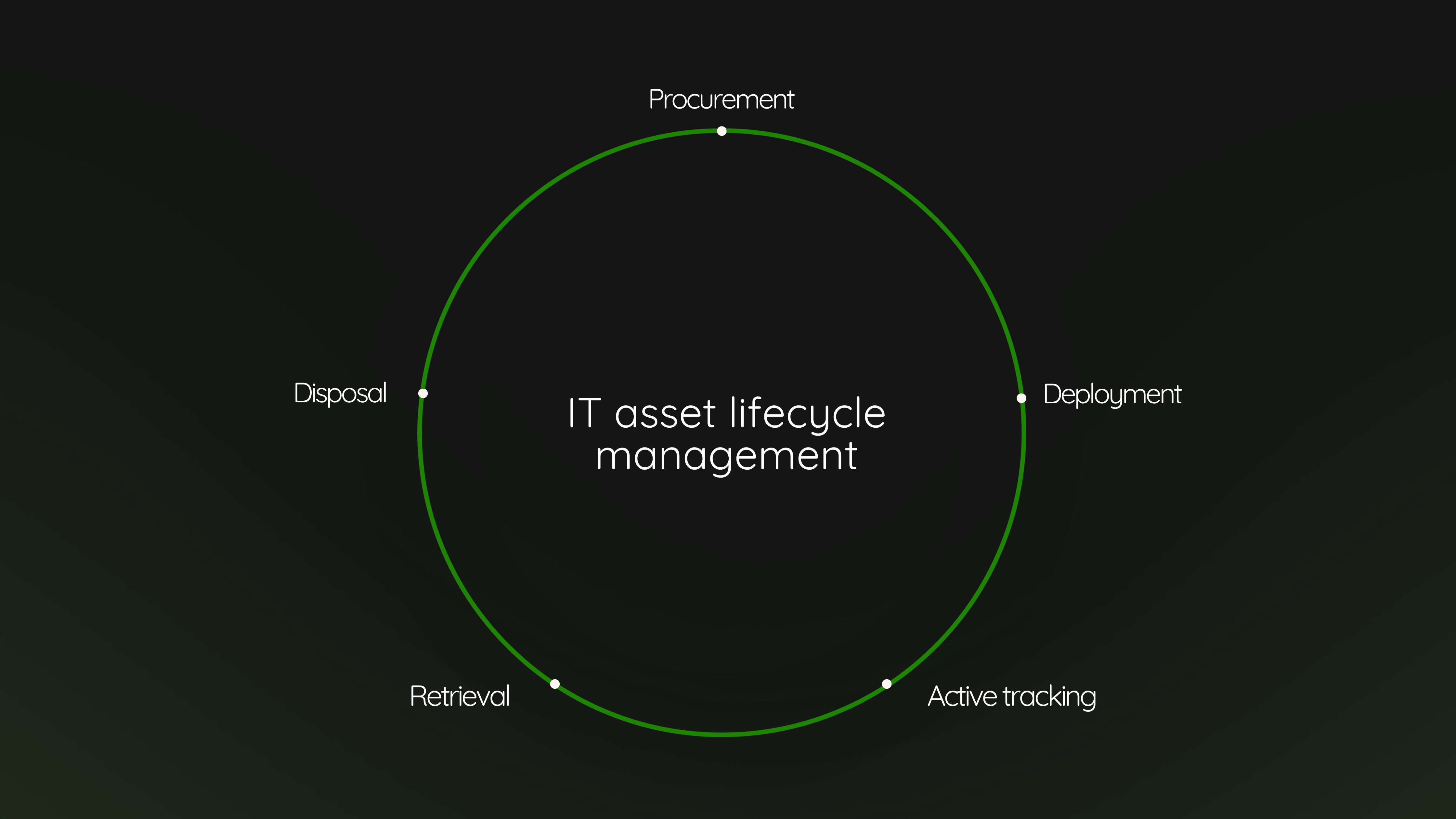
The five stages of the IT device lifecycle
Stage 1. Procurement
This is where the lifecycle begins. Procurement means deciding what devices the company needs, sourcing them, and getting them ready to deploy.
For a team in one country, this is straightforward. For a distributed team, it immediately gets complicated. You cannot ship a laptop from your headquarters in Tallinn to a new hire in Brazil without thinking about customs, duties, lithium battery restrictions, and transit time. In Brazil, import duties alone can reach 38% of the device's value.
The smarter approach most distributed teams are moving toward: source devices locally in the country where the employee is based, rather than shipping from a central hub. This eliminates most cross-border friction and gets devices to employees faster.
Stage 2. Deployment
Deployment means getting the right device to the right person, configured and ready to use, on or before their first day.
This sounds simple. In practice it involves: packaging the device securely, coordinating delivery logistics, handling customs documentation if shipping internationally, and ensuring the device is enrolled in your ITALM (IT asset lifecycle management) system before it arrives.
The most common failure point here is timing. A device that arrives three days after a new hire's start date has already created a negative first impression. For People Ops teams, this is not an IT detail, it is an employee experience issue.
Stage 3. Active use and asset tracking
Once a device is deployed, it needs to be tracked. This means knowing:
- Who has which device
- Where it is located
- What its condition is
- When it was last updated or audited
- When it is due for replacement
Without a system for this, companies end up with what most IT managers describe as "the spreadsheet problem", a shared Google Sheet that was accurate six months ago and is now nobody's responsibility.
At scale, poor asset tracking has real consequences. Unretrieved devices sitting in former employees' homes often still have access to company systems. Device retrievals after employee offboarding encounter three main problems: employee device refusal, delivery issues, and communication problems.
Stage 4. Retrieval and offboarding
Retrieval is the stage that breaks most in-house processes. When an employee leaves, the company needs the device back. This involves:
- Notifying the employee of the return process
- Providing return packaging and a pre-paid label
- Coordinating a carrier pickup or drop-off
- Tracking the shipment
- Confirming receipt and condition
- Wiping the device securely before redeployment
For domestic employees, this is annoying but manageable. For international employees it becomes a project. Different carriers handle cross-border returns differently. Some countries require specific commercial documentation. Many employees no longer have the original packaging. And once someone has left a company, their responsiveness drops sharply.
The companies that consistently recover devices have one thing in common: they send a return kit to the employee before their last day, not after. Pre-packaged, pre-labelled, with clear instructions. The easier the process is for the employee, the more devices come back.
Stage 5. Retirement and disposal
Every device eventually reaches the end of its life. At this stage, companies need to decide: redeploy, resell, or retire.
Redeployment is the most cost-efficient option. A retrieved device that has been wiped and checked can be reissued to a new employee, extending its useful life and reducing procurement costs.
Resale works for devices that are too old for internal reuse but still have market value.
Retirement and recycling applies to devices that are beyond use. This is not just about clearing space. In Europe, companies with ESG reporting obligations are increasingly required to document how devices are disposed of. The Corporate Sustainability Reporting Directive (CSRD), which now applies to companies with 250+ employees across the EU, includes IT equipment disposal as part of environmental reporting.
Secure data wiping must happen regardless of which retirement path a device takes. GDPR requires that personal data is properly deleted before a device leaves company control. This means a factory reset is not sufficient, certified wiping to NIST 800-88 standards is the recognized benchmark.
Why growing teams struggle with device lifecycle management
Small teams manage devices informally and it works fine. The problems emerge at three specific growth points.
When the team crosses 30–50 people. At this scale, someone needs to own device tracking. The ad hoc approach, someone remembers who has what, stops working. Devices get lost. New hires wait longer than they should because nobody has a clear procurement process.
When the company hires across borders. The moment a company has employees in more than one country, every stage of the lifecycle gets harder. Procurement involves customs. Deployment involves international logistics. Retrieval involves coordinating across time zones with people who may not speak the same language as your IT team.
When the company scales hiring fast. High-growth companies are onboarding and offboarding people constantly. The manual effort, half a day per device, per move, in IT time, compounds quickly. At 50 device moves per year, that is 25 days of IT time spent on logistics.
How distributed teams manage device logistics in practice
There are three common approaches. Each involves real tradeoffs.
Handle it in-house. The IT team manages procurement, shipping, tracking, and retrieval themselves. This gives maximum control and zero vendor dependency. It works well for small teams in one or two countries. At scale or across many countries, it becomes a full-time job that was never budgeted for.
Buy locally for each hire, write off on departure. When international shipping is too complex, some companies simply buy a new device locally for each hire and let departing employees keep or dispose of their device. This solves the logistics problem but creates a different one: no asset tracking, no security controls on retirement, and significant cost accumulation over time.
Use a device operations platform. Platforms like Raal handle the end-to-end process: procurement, packaging, cross-border logistics, customs, insurance, tracking, return kits for leavers, and secure disposal. IT places an order in five minutes. The platform handles everything else. This approach trades some control for significant time savings — the measurable benchmark is typically from three-plus hours of IT coordination per device down to a five-minute order.
Frequently asked questions
What is the difference between IT asset management and IT asset lifecycle management?
IT asset management (ITAM) is often used to describe the tracking and inventory of company technology assets, knowing what you own, where it is, and what it is worth. IT asset lifecycle management (ITALM) is the broader operational process that includes ITAM but also covers procurement, deployment, retrieval, and disposal. ITALM describes the full process; ITAM often refers to the tracking and visibility layer within it.
How do companies manage laptops for remote employees across different countries?
The main approaches are: shipping from a central hub (cost-effective but slow and complex for cross-border), local procurement in-country (fast but creates hardware inconsistency), employee stipends to buy locally (fast but creates security and support issues), and managed device operations platforms that handle logistics, customs, and retrieval end-to-end. For teams with employees in more than two or three countries, a managed platform is typically the most scalable option.
What happens to data on a device when an employee leaves?
GDPR and equivalent data protection regulations require that personal and company data is securely wiped from a device before it is reissued or disposed of. A standard factory reset is not compliant, it does not permanently erase data. Certified wiping to NIST 800-88 standards is the recognized requirement. Most managed device platforms handle this as part of the offboarding process and provide a certificate of destruction for audit purposes.
How long does the average company laptop last before it needs replacing?
Most business laptops have an effective working life of three to five years. Performance, battery health, and security support (whether the OS is still receiving updates) are the practical factors that determine replacement timing. Lifecycle management platforms can track device age and flag devices approaching end of useful life, enabling proactive refresh planning rather than reactive replacement when devices fail.
What is a return kit and how does it work?
A return kit is a pre-packaged, ready-to-ship box sent to a departing employee before their last day. It includes appropriate protective packaging, a pre-printed return label, and clear instructions for packing and returning the device. Return kits dramatically improve device recovery rates because they remove the main friction points: the employee does not need to source packaging or arrange shipping. Companies using return kits consistently recover more devices and receive them in better condition than those relying on employees to arrange their own returns.
Is device lifecycle management relevant for companies below 50 employees?
For companies with one or two countries and stable headcount, informal tracking is usually sufficient. The moment a company starts hiring internationally, even a single employee in a different country, device logistics becomes operationally complex. Cross-border procurement, international retrieval, and customs compliance all require deliberate processes regardless of company size.
What is CSRD and how does it affect device disposal?
The Corporate Sustainability Reporting Directive (CSRD) is an EU regulation that requires companies above certain thresholds to report on their environmental, social, and governance (ESG) activities. From 2026, it applies to companies with 250 or more employees or meeting specific financial thresholds. IT equipment disposal, including secure data wiping, reuse decisions, and recycling, falls under the environmental reporting requirements. Companies that can document responsible device retirement are in a better position for compliance and audit purposes.
The bottom line
IT asset lifecycle management is not a tool you buy. It is an operational discipline, the set of decisions, processes, and systems your company uses to manage devices from the day they are ordered to the day they are retired.
For companies with employees in one country and stable headcount, informal processes work. For companies with distributed teams, frequent hiring and offboarding, or employees across multiple countries, the informal approach accumulates into a significant operational cost: in IT time, in unrecovered assets, and in security exposure from unmanaged devices.
The companies that get this right early treat device logistics as infrastructure. Not something IT figures out as it goes, but a deliberate process with the same level of attention as payroll or cloud hosting.
Raal is a device operations platform for global teams. We handle the full lifecycle, procurement, cross-border delivery, customs, tracking, retrieval, and sustainable disposal, across 150+ countries. IT places an order in five minutes. We handle the rest.
→ See how it works at raal.io or run a cost estimate at raal.io/estimate/