There is a version of this conversation that happens in almost every company between 30 and 300 employees.
Someone in IT or Operations says: "Should we just keep handling device logistics ourselves, or is there a better way?"
And then, because it is not a burning crisis, nothing changes. The status quo wins by default.
This article is for the teams actually trying to make that decision. Not a sales pitch, but a real breakdown of what in-house device management costs, where it breaks, and when a managed approach like Raal makes financial and operational sense.
First, what are we actually comparing?
This article is specifically about device operations, the physical logistics of managing company hardware across its full lifecycle. That means:
- Getting laptops to new hires, on time, configured correctly
- Tracking devices while they are in use
- Recovering devices when employees leave
- Storing, redeploying, and retiring hardware responsibly
This is different from IT support, MDM, or cybersecurity, which are separate functions entirely. If you are thinking about those, that is a different conversation. This one is purely about the operational layer: moving, tracking, and managing physical devices for a distributed team.
If you are new to this category, our guide to IT asset lifecycle management covers the full picture before you read this comparison.
The real cost of doing it in-house
Most teams assume in-house device management is essentially free, it is just IT doing what IT does. The hidden cost is time, and it accumulates fast.
Labour time per device
Every device move, onboarding a new hire, retrieving a device from a leaver, redeploying a returned laptop, involves coordination. Based on conversations with hundreds of IT managers, the consistent number is 3 or more hours of IT time per cross-border device move. That covers:
- Sourcing or tracking down appropriate packaging
- Arranging a carrier and coordinating pickup or drop-off
- Preparing customs documentation for cross-border shipments
- Communicating with the employee through the process
- Following up when something goes wrong in transit
- Logging the device in and out of inventory
At €50–€80 per hour for a senior IT specialist's fully-loaded time, that is €150–€240 in labour cost per device move before a single €1 is spent on packaging or shipping.
Packaging and shipping
Sourcing appropriate packaging for a laptop, packaging that actually protects the device in transit, typically costs €15–€30 per shipment if not bulk-purchased. Carriers charge €20–€80 for standard cross-border shipping within Europe, depending on speed, weight, and destination. Add insurance for a device worth €1,200–€1,800, and a realistic per-device cost for a domestic-to-international move sits at €200–€350 in direct costs before labour.
Customs for cross-border moves
Within the EU, intra-community device moves avoid duties but still require proper documentation, commercial invoices, HS codes, declared values. Between the EU and UK post-Brexit, import procedures apply in both directions, including Postponed VAT Accounting for UK businesses and potential delays at customs.
Getting this wrong, wrong commodity code, missing documentation, incorrect declared value, triggers delays, additional fees, or customs holds. Our full guide to moving IT devices across borders covers the 21 countries with the most complex requirements, including documentation specifics for each.
The write-off problem
Companies managing device retrieval in-house consistently underperform on recovery rates. According to Capterra's research, 71% of HR professionals have seen at least one departing employee fail to return company equipment. The average hardware value of an unreturned laptop is €1,000–€1,800. For a company offboarding 15–20 people per year with a 20% non-return rate, that is €3,000–€7,000 in written-off assets annually — simply because the retrieval process was too inconvenient for the departing employee to complete.
More on how to close this gap: How to recover laptops from remote employees when they resign.
The total picture — an honest estimate
For a company doing 30 device moves per year across multiple countries:
| Cost component | In-house estimate |
|---|---|
| IT labour (3 hrs × €60/hr × 30 moves) | €5,400 |
| Packaging and shipping (avg €60 × 30) | €1,800 |
| Written-off devices (20% loss × avg €1,400) | €8,400 (on 30 devices) |
| Customs errors and delays (estimated) | €500–€2,000 |
| Total annual cost | €16,100–€17,600 |
That is before accounting for the opportunity cost of what your IT team could be doing with those 90+ hours.
What the in-house model is actually good at
Fair is fair. In-house device management has genuine advantages, and there are scenarios where it is the right call.
When you are in one country with a small team. If everyone is in the same city, device logistics is a minor operational task. You do not need a platform or a partner for 10 laptops in one office.
When you have unusual device requirements. Some companies have highly specific hardware configurations, security requirements, or custom builds that require hands-on IT involvement at every device move. If your setup is genuinely non-standard, a managed platform may not fit without customisation.
When you have very low device volume. Below around 15–20 device moves per year, the time investment in setting up and learning a new platform may exceed the time saved. This inflection point shifts as you grow.
When your team is genuinely not stretched. If your IT team has bandwidth to spare and enjoys this work, there is no compelling reason to change. The case for outsourcing is strongest when device logistics is creating friction, stress, or opportunity cost.
Where in-house consistently breaks down
For most growing companies, the in-house model hits its limits at three specific moments.
The first international hire
The moment a company hires in a second country, every stage of device management gets harder. Customs, carrier selection, packaging requirements, import documentation — these are not problems IT teams were trained for, and they compound quickly. What used to take 30 minutes takes half a day.
The first quarter of rapid hiring
Rapid growth creates device logistics debt. If a company is onboarding 5–10 people per month across multiple countries, IT becomes a logistics coordinator by default. The hours do not scale linearly — they scale faster, because coordination complexity increases with each additional country.
The first batch of international leavers
Getting devices back from employees in other countries is harder than getting devices to them. Most in-house teams underestimate this until it happens. There is no box. There is no return label. The employee has mentally moved on. And the device — worth €1,400 — sits in an apartment in Lisbon. Our guide to recovering laptops from remote employees covers exactly what to do here.
What Raal costs and what you get
Raal operates on a pay-as-you-go model for smaller teams and subscription plans for teams with consistent volume. There is no setup fee and no minimum commitment on the pay-per-use plan.
Pay as you go: No subscription. You pay per device move, onboarding delivery, offboarding retrieval, or redeployment. Every move includes packaging, carrier coordination, customs handling, insurance, and tracking. You see the exact cost before confirming.
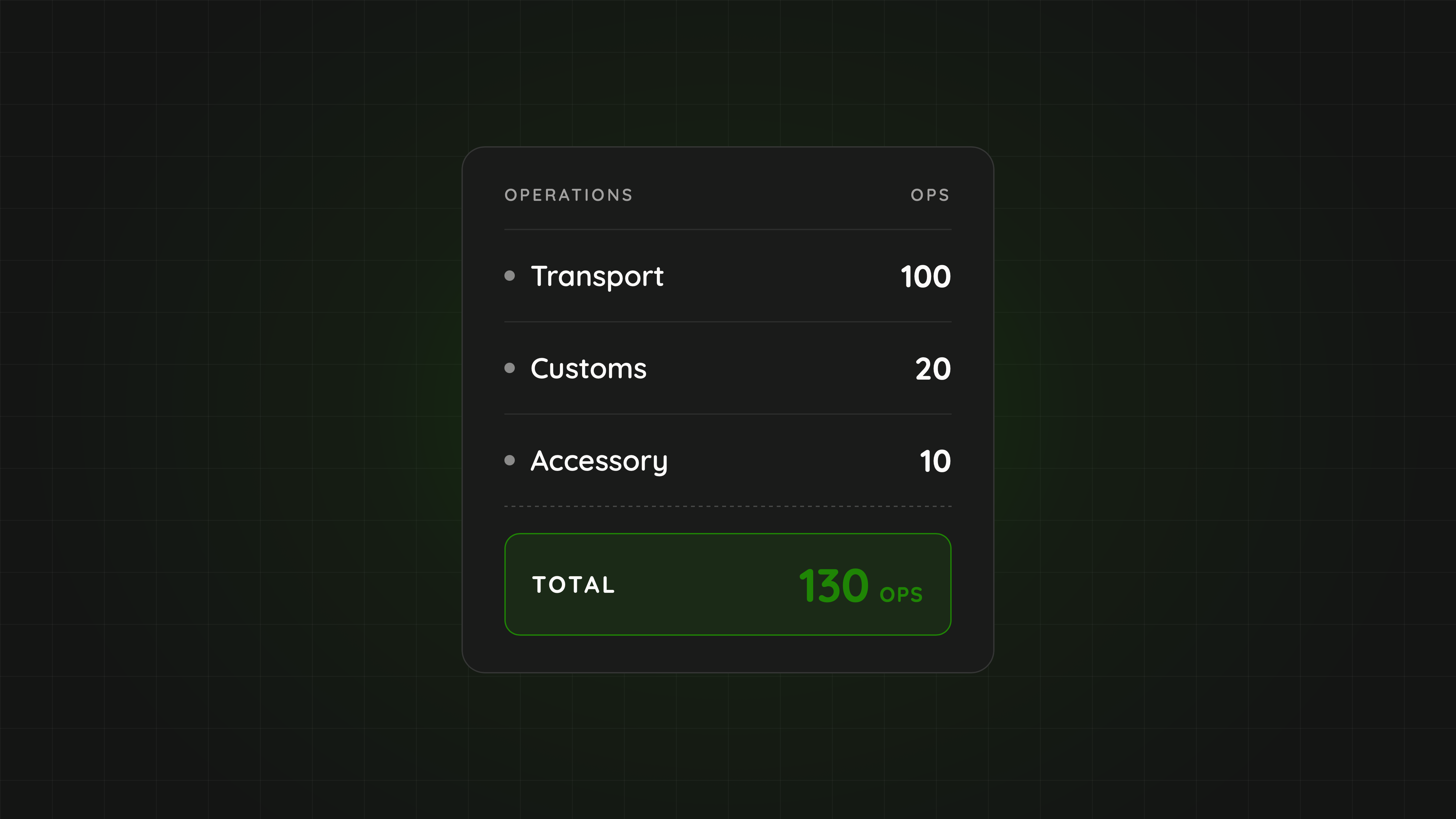
Starter from €125/month: Includes 100 OPS credits per month, roughly enough for a team doing 8–12 device moves per month. Includes shipping, customs, insurance, and dashboard tracking for the whole team.
Pro from €345/month: For teams doing higher volume. Adds HR system integration, complex customs handling, role-based access, and priority support.
Business from €1,050/month: For scale-ups. Includes SSO, bulk operations, dedicated success manager, and guaranteed response times.
You can run an exact cost estimate for your team's device volume at raal.io/estimate
What every Raal order includes
Regardless of plan, every device move with Raal includes:
- Tested, protective transport packaging sent to the employee or employer
- Carrier coordination and booking
- Customs documentation for cross-border moves
- Full freight insurance for the device's replacement value
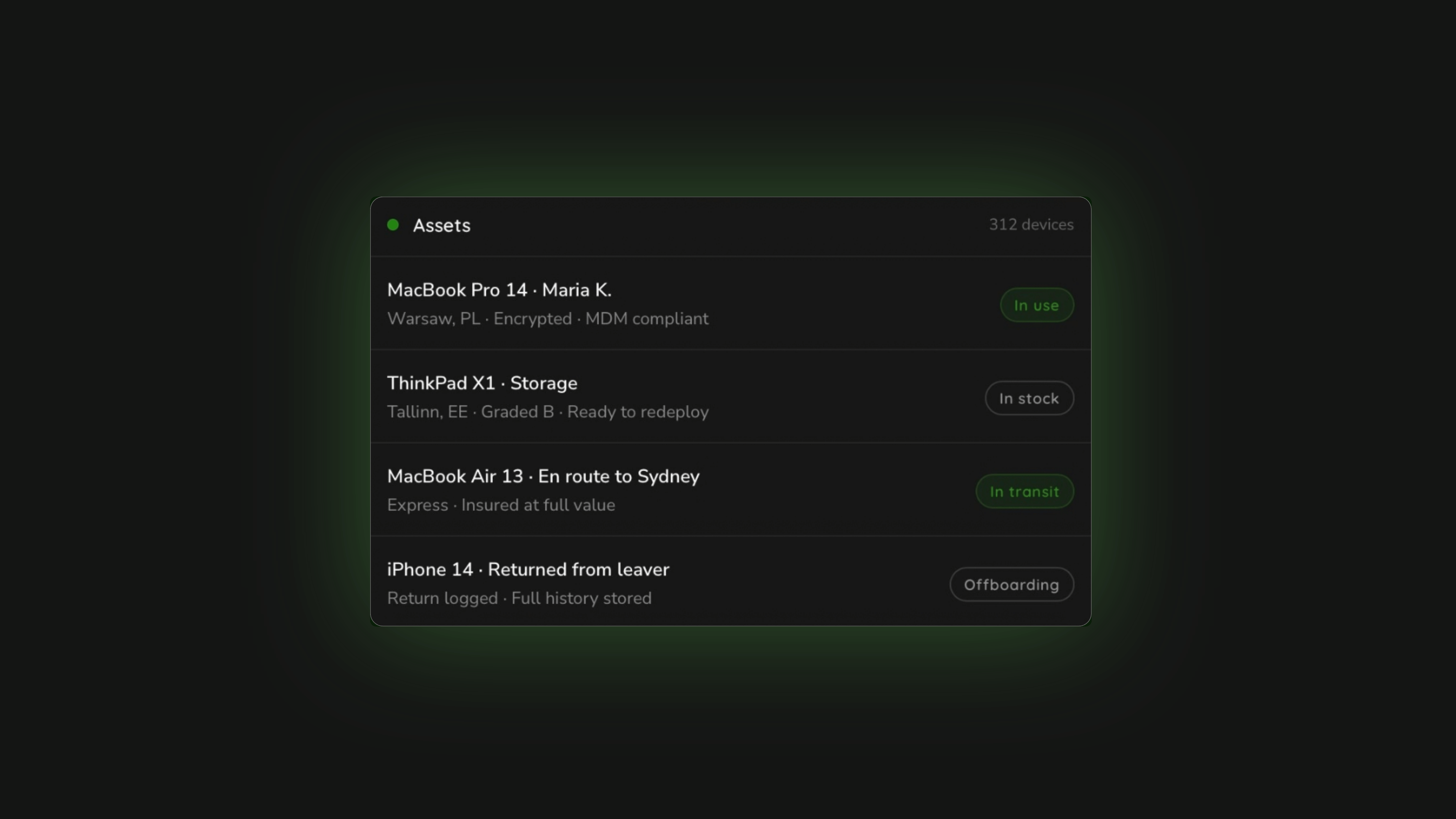
- Real-time tracking via the Raal dashboard
- Hands-on support if anything goes wrong in transit
- Return kit for offboarding moves — sent to the leaver's door before their last day
IT places the order in 5 minutes. Raal handles everything else.
Side-by-side comparison
| In-house | Raal | |
|---|---|---|
| Time per device move | 3+ hours IT time | 5 minutes to place order |
| Cross-border customs | Manual, error-prone | Handled by Raal |
| Packaging | Self-sourced, variable quality | Tested protective packaging included |
| Insurance | Separate, often insufficient | 100% included, full replacement value |
| Device tracking | Spreadsheet or ad hoc | Live dashboard |
| Offboarding retrieval | Manual chase process | Return kit sent to employee's door |
| Asset visibility | Patchy | Full lifecycle tracking |
| Sustainable disposal | Unstructured | Secure wipe, reuse, responsible recycling |
| Pricing model | Hidden in IT labour | Transparent, per move or monthly |
| Scales with growth | Linearly harder | Same process at 5 or 500 devices |
When the maths works in Raal's favour
The crossover point — where a managed approach costs less than in-house — is lower than most teams expect.
For a company doing 30 device moves per year at an average of €120 per move with Raal (including packaging, shipping, customs, and insurance), the total cost is €3,600. Compare that to the €16,100–€17,600 in-house estimate above, including labour, shipping, and written-off devices.
Even stripping out the written-off device cost (assuming a perfect recovery rate, which nobody achieves), the in-house labour and shipping cost alone — €7,200 — still exceeds the Raal cost.
The maths shift toward in-house when device volume is very low (under 15 moves per year), all moves are domestic, and the IT team has genuine spare capacity. In every other scenario, a managed approach typically costs less when total cost is calculated honestly.
The sustainability angle
One consideration that is increasingly relevant for European companies: what happens to devices at end of life.
The Corporate Sustainability Reporting Directive (CSRD) requires companies above certain thresholds to report on environmental impact, including IT equipment disposal. A company writing off unreturned laptops, disposing of retired devices without secure wiping, or sending hardware to landfill is building an ESG liability.
Raal handles secure data wiping to NIST 800-88 standards, provides certificates of destruction for audit purposes, and routes retired devices through responsible reuse and recycling channels. For companies building their ESG reporting practice, this is infrastructure, not a nice-to-have.
More on this in: Smart and Sustainable: Raal's IT Asset Logistics and ESG Efforts and What to Do with Old Company Laptops.
Frequently asked questions
Does using Raal mean our IT team loses control of device management?
No. IT retains full visibility via the Raal dashboard, every device, every move, every status update in real time. The difference is that the operational execution (packaging, carriers, customs, coordination) is handled by Raal. IT places the order and monitors progress. Control stays with your team; the logistics work moves to ours.
Can Raal handle custom device configurations or specific hardware requirements?
Yes for logistics. Raal handles the movement, packaging, customs, and retrieval of devices regardless of model or configuration. MDM enrollment and device configuration are handled by your existing IT setup, Raal is the physical logistics layer, not a replacement for your MDM.
What happens if a device is damaged or lost in transit?
Every Raal shipment is fully insured for the device's replacement value. If something goes wrong in transit, Raal handles the claim. This is included in every order at no extra cost, not an optional add-on.
We only have a few international employees. Is Raal worth it at small scale?
The pay-as-you-go plan has no minimum commitment, so you pay only for the moves you make. For a team doing 3–4 international device moves per year, the per-move cost is typically lower than the combination of packaging, shipping, customs handling, and IT time the equivalent in-house move would require. Use raal.io/estimate to see exact numbers for your situation.
How does Raal handle the UK specifically, post-Brexit?
EU-to-UK and UK-to-EU shipments require customs documentation, commodity codes, and in some cases import VAT handling. Raal manages this as standard, it is included in the service, not a surcharge. Our UK import VAT guide covers the regulatory context in detail.
Does Raal work for device redeployment — sending a retrieved laptop to a new hire?
Yes. This is one of the most cost-efficient use cases. A device retrieved from a leaver in Germany can be stored and redeployed to a new hire in the Netherlands, tracked end to end, without your IT team coordinating any of the logistics. This closes the loop between offboarding and onboarding and reduces procurement costs significantly.
The decision framework
Use in-house device management if:
- Your team is in one country and under 30 people
- Device volume is under 15 moves per year
- Your IT team has clear bandwidth for logistics work
- You have no international employees or leavers
Consider Raal if:
- You have employees in more than one country
- You are doing more than 15–20 device moves per year
- Your IT team is spending measurable time on logistics coordination
- You have had devices not returned, arrive late, or get damaged in transit
- You need ESG-compliant device disposal
Start with the cost estimator it takes 2 minutes and gives you an exact number for your situation.
Raal handles the full device lifecycle for global teams — procurement, cross-border delivery, customs, tracking, retrieval, and sustainable disposal. Across 150+ countries. IT places the order in 5 minutes. We handle everything else.
→ See how it works at raal.io or run a cost estimate at raal.io/estimate