
Raal vs Deel IT
Is Raal or Deel IT the better device operations platform for companies that already own their fleet?
Raal is a movement-and-customs specialist that works with the devices a company already owns, billed per operation with no per-seat fees. Deel IT is a procurement-included device module of Deel's HR and EOR platform, billed per seat with per-device add-ons. Choose Raal if you own your fleet and want usage-based pricing. Choose Deel IT if you are already running Deel for HR.
Last reviewed: 5 May 2026. Next review: 5 August 2026. Maintained by the Raal team. How we compare.
Raal and Deel IT solve different parts of the same problem. Raal is a movement-and-customs specialist that works with the devices a company already owns, billed per operation with no per-seat fees. Deel IT is a procurement-included device module of Deel's HR and EOR platform, billed per seat with per-device add-ons. Choose Raal if you own your fleet and want usage-based pricing. Choose Deel IT if you are already running Deel for HR and want device management folded into the same contract.
At a glance
| Raal | Deel IT | |
|---|---|---|
| Works with devices you already own | Yes, core use case | Secondary, primarily a procurement platform |
| Pricing model | Pay-as-you-go or operation-based (OPS credits) | Per-seat, plus per-device and per-user add-ons |
| Pricing transparency | Published on raal.io/pricing | Add-on pricing published; base module commonly quoted around $99/month, full quote requires sales |
| Pay only for operations you run | Yes | No, seats billed regardless of usage |
| No-subscription option | Yes, PAYG with no monthly fee | Free Default Plan exists for existing Deel customers, full features require Paid Plan |
| Transport cost model | Pass-through on subscription tiers (customer benefits from courier volume discounts), flexibility premium on PAYG | Bundled inside service fees |
| Hardware markup | None. You keep your vendor pricing, Raal handles everything after the purchase. | Devices are typically purchased through the platform at a premium over retail. |
| Domestic delivery (devices originating in-country) | 33 countries (UK, EU member states, USA, Georgia), expanding to meet customer demand | Procured-locally model, 60+ countries for zero-touch Apple, 40+ for Windows Autopilot |
| International cross-border shipping | 150+ countries for laptops, monitors, accessories | 130+ countries through global network |
| Delivery speed | Express (1-3 days) or economy (4-9 days), customer chooses per order | Sub-10-day global delivery target |
| Bulk device moves with dangerous goods handling | Coordinated special request, full IATA/IMDG/ADR workflow, requires designated contact at collection point | Not a published core capability |
| Customs handling | Full documentation, HS code classification, clearance, cost optimisation through correct filing, import VAT reimbursement structured where the destination country allows (case-by-case, UK is one example) | Handled inside global operations, less granular cost visibility |
| Insurance | Included by default on every delivery, Raal handles claim paperwork, customer provides minimum proof (typically photos) | Not published as default, separate coverage |
| HR/payroll integration | BambooHR today, works alongside other HRIS | Native to Deel HR, payroll, EOR |
| Compliance certifications | EU-based (Estonia), GDPR by default, SOC 2 not yet attested | SOC 2 Type II, ISO 27001 |
| Best for | Companies with existing fleets that want usage-based pricing and customs expertise | Companies already standardised on Deel for HR and EOR |
What Raal does today
Raal is a focused IT device operations platform built around moving the devices a company already owns. Most companies own the laptops their employees use, and the hard part is getting those devices to and from people across borders without losing days of IT time per shipment.
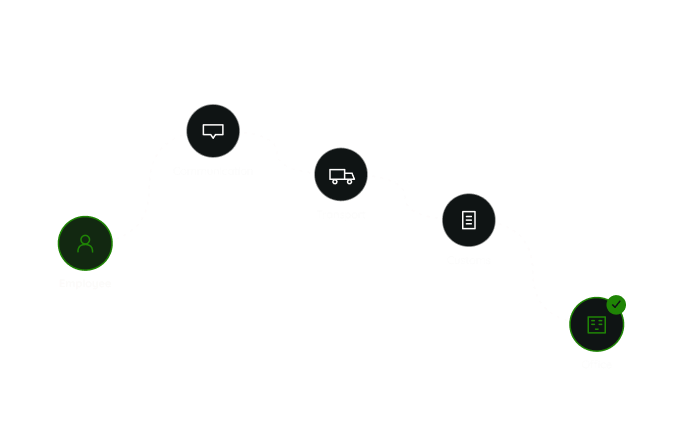
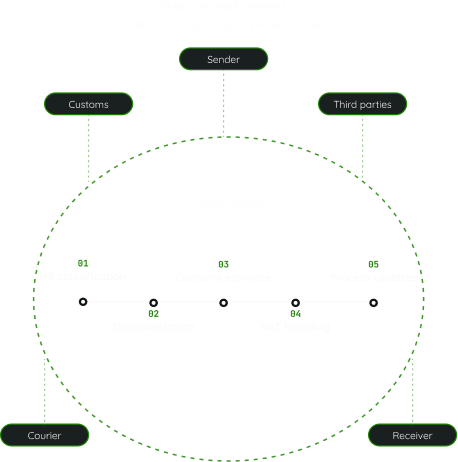
Raal handles four things on every shipment: communicating with the receiving employee, providing tested transport packaging with packing instructions, preparing customs documentation and managing clearance, and coordinating the carrier. Customers place an order in the customer portal, choose delivery speed (express 1-3 days or economy 4-9 days), and the device gets to the employee with full transit insurance included by default. Domestic delivery is live across 33 countries today (UK, all EU member states, USA, and Georgia), and international cross-border shipping reaches 150+ countries.
Raal does not sell, lease, or repair devices, and does not manage device software. Companies use Raal alongside their existing MDM (Jamf, Intune, Kandji) and their existing procurement vendor.
What Deel IT does today
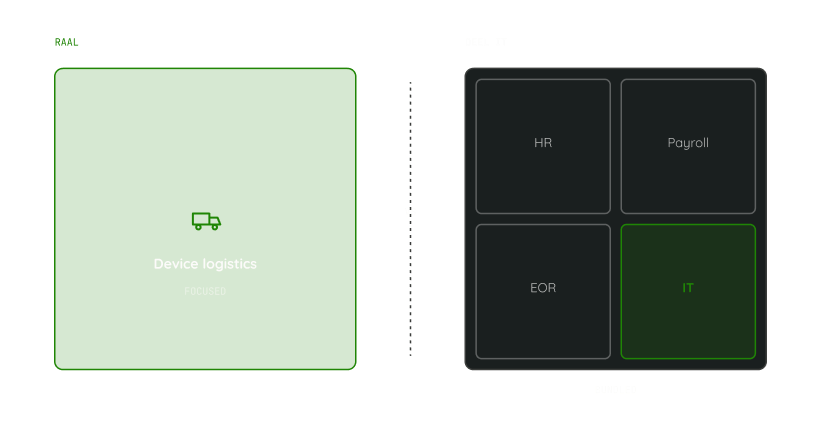
Deel IT is the device operations layer of Deel's HR, payroll, and EOR platform, built on the team Deel acquired from Hofy. It centralises procurement, pre-configuration, shipping, repairs, and offboarding, and integrates natively with Deel's HR workflows so that hiring and offboarding events can trigger device provisioning or retrieval automatically.
Deel IT operates in 130+ countries, supports zero-touch Apple provisioning in 60+ countries and Windows Autopilot in 40+, and holds SOC 2 Type II and ISO 27001 attestations. Core services are surrounded by priced add-ons: Mobile Device Management at $9 per device per month unmanaged or $12 managed, 24/7 tech support at $99 per user per month, certified data erasure at $90 per device, and BYOD activation at $100 per device plus ongoing storage fees.
The base Deel IT module is commonly quoted around $99 per month, layered on top of whatever Deel HR or EOR contract the company is on. Source: deel.com/solutions/it.
Working with devices you already own
This is where the two services have a fundamentally different starting point.
Raal treats existing company-owned devices as the default. Customers do not need to re-buy or re-lease hardware to use the service. Raal ships, delivers, and handles customs for devices already in the fleet, including company laptops sitting in storage, devices being relocated between employees, and equipment moving across borders as teams expand or restructure.
Deel IT is primarily designed around procurement and ongoing management of devices purchased or leased through the platform. BYOD and third-party hardware are supported as secondary workflows with their own pricing ($100 activation per device, $20 per device per month for BYOD storage after the first month). For companies that already own their hardware and do not want to change procurement vendors, this is a material difference in both cost and workflow.
Pricing: what the two models actually look like
The pricing models start from different assumptions about what to bill for.
Raal uses pay-as-you-go or operation-based pricing. Pay-as-you-go has no monthly subscription, suited to teams running occasional shipments and willing to pay a flexibility premium for the absence of any commitment. Subscription plans allocate monthly OPS (Operational Point System) credits that are spent on specific actions like shipments, customs clearance, and API calls. Monthly plans start at €159 for Starter and scale through Pro, Business, and custom Enterprise tiers, with yearly billing carrying a 10% discount and a bonus 13th month of OPS. On subscription tiers, transport costs are passed through directly to the customer, which means customers benefit from the volume discounts Raal negotiates with courier partners. On PAYG, transport costs carry a flexibility premium that reflects the no-commitment model. Teams running more than a few shipments per quarter typically save meaningfully by moving to a subscription tier. No per-seat fees apply on any tier regardless of how many employees are in the company. See raal.io/pricing for the full OPS breakdown.
Deel IT uses a per-seat model layered with add-ons. There is a free Default Plan for existing Deel customers covering basic procurement and asset tracking, and a Paid Plan priced per worker per month that unlocks full features. On top of that, specific capabilities are priced as add-ons that accumulate per device and per worker. The base Deel IT module is commonly quoted around $99 per month, stacked on top of an underlying Deel HR or EOR contract. The full cost becomes visible only after mapping every feature a team uses against the line items, and costs scale with headcount whether or not those employees triggered any device operations in a given month.
The practical difference for finance teams. Raal's cost matches what was actually done. Deel IT's cost scales with seats and add-ons regardless of monthly activity. For a 100-person company that moves 8 devices in a quiet month, Raal bills only for those 8 operations. Deel IT bills the full seat count plus active add-ons.
Raal doesn't resell hardware, so there's no markup on your devices. You buy from your own vendors at your own prices, and we can collect directly from your supplier to handle configuration, shipping, and customs onward. Bundled hardware offerings in this industry commonly carry a 25 to 30 percent premium built into the device price.
Pricing accurate as of 5 May 2026. See raal.io/pricing for current Raal pricing and deel.com for current Deel IT pricing.
Customs handling, the cross-border advantage
Customs is where Raal's specialisation shows up most clearly.
Raal moves devices through customs as a core part of the service. Documentation, HS code classification, and clearance filings are handled by Raal, and the customer receives customs cost indications before shipments go out. Correct filing matters because misclassified devices or missing paperwork generate avoidable duties, storage fees at bonded warehouses, and broker fees that multiply per-device cost. Raal's customs expertise is built into the offering as a discrete operation rather than sold as a monthly add-on.
Where the destination country allows it, Raal also structures customs declarations so customers can reclaim import VAT or avoid paying it up front entirely (the UK is one example). This applies to customers who meet country-specific VAT reimbursement criteria and requires a prior agreement with the customer's finance or accounting team on the process.
Deel IT handles cross-border movement across 130+ countries with a sub-10-day delivery target. Execution is capable at scale, but customs cost visibility is less granular before shipments dispatch. For procurement and finance teams working to defensible per-shipment budgets, this is a meaningful operational difference.
Insurance included by default
Every Raal delivery is insured by default. When placing an order, the customer provides an estimated device value, and that value is used for both customs clearance and insurance coverage. If a device is lost, damaged, or stolen in transit, Raal does not fight the claim. The customer provides the minimum proof the insurer requires (typically photos and sometimes a short application), and Raal walks the customer through the process and handles the rest of the paperwork.
Deel IT does not publish default transit insurance as a core capability. Customers concerned about coverage on high-value shipments typically have to arrange it separately and manage any claims process themselves.
Bulk device moves and dangerous goods handling
Laptops contain lithium batteries, which means any shipment of more than 4 devices triggers dangerous goods (DG) regulations: IATA rules for air, IMDG for sea, ADR for road. Most device-management vendors quietly avoid this category by capping at single-device, single-employee shipments.
Raal handles bulk device moves as a coordinated special request. These are organised through direct communication with customer representatives and require collaboration with a designated person at the collection point to prepare devices, complete inventory, and hand off to the carrier. The service covers the full dangerous goods workflow: DG documentation, packaging compliance, carrier coordination, and mode selection across air, sea, and road. Typical use cases include office shutdowns, country exits, consolidation of devices collected at a single point that need to move elsewhere, and reorganisations that generate large quantities of hardware needing relocation.
Deel IT does not publish bulk dangerous goods handling as a core capability. Customers facing office shutdowns or large-scale device consolidation typically have to coordinate this separately through freight forwarders, which adds vendor management overhead at exactly the moment teams are stretched thin.
Switching from Deel IT to Raal
A common scenario, especially for companies that adopted Deel IT for the HR integration but realise they are paying per-seat for limited movement activity.
You keep your devices. Raal does not own or lease the hardware. The devices Deel IT helped you procure remain your property, and Raal moves them when needed.
You can keep Deel HR or EOR. Switching device logistics to Raal does not require ending your Deel HR contract. Many Raal customers run Deel for payroll or EOR while using Raal for device movement, because the two layers do not need to share a vendor. Raal works alongside any HRIS.
Migration is gradual. New shipments go through Raal, existing in-flight shipments finish through Deel IT. There is no bulk data migration to coordinate, because Raal does not maintain a central asset database. Customers who want centralised asset tracking continue using Deel IT's asset features or a dedicated MDM/ITAM tool while routing logistics through Raal.
You exit the per-seat structure. This is usually the financial reason to switch. Companies with 100+ seats but variable shipment activity typically see meaningful savings moving to operation-based pricing, because Deel IT's per-seat fees and add-ons scale with headcount, not activity.
Where Deel IT is genuinely stronger
An honest comparison has to address this directly.
Brand recognition and scale. Deel is a much larger, more widely known company. For procurement teams that weight vendor maturity heavily, Deel's size and funding are real signals.
Full-lifecycle coverage today. Deel IT offers in-platform repair routing, loaner workflows, certified data erasure, BYOD handling, and offboarding retrieval as native features. Raal's scope today is the transport and coordination side of the lifecycle: arranging moves, handling customs, and communicating with employees. Companies that need in-platform repair routing, loaner management, or certified offboarding should evaluate that gap.
Enterprise compliance surface. Deel IT has SOC 2 Type II, ISO 27001, extensive SSO and SCIM coverage, and a large partner catalogue. Raal is GDPR-compliant by default as an EU-based operator (Estonia), but does not yet hold SOC 2 attestation. For procurement teams that require SOC 2 as a baseline, this is a hard requirement Raal does not yet meet.
HR and payroll integration. If payroll, EOR, or contractor management already runs on Deel, the native sync between HR events and device events is a real workflow advantage. Raal does not offer HR or payroll itself and integrates with BambooHR today, running alongside whatever other HRIS is already in place.
Local procurement. Deel IT's procured-locally model can reduce customs exposure when devices are sourced in the destination country rather than shipped across borders. For companies with high per-country headcount and willingness to procure through Deel, this can be operationally simpler.
When to choose which
Compare with other vendors
- Raal vs GroWrk
- Raal vs Workwize (coming soon)
- Raal vs Firstbase (coming soon)
- Full vendor reference
Bottom line
Best for companies with existing fleets that want usage-based pricing, transparent per-operation costs, customs expertise with VAT reimbursement, and default transit insurance, without paying per-seat fees.
Best for companies already standardised on Deel for HR, payroll, or EOR who want native HR-to-device workflow integration, full in-platform lifecycle (repairs, loaners, certified offboarding), and SOC 2 Type II / ISO 27001 attestations.
Frequently asked questions
What exactly does Raal do?
How does Raal's pricing work?
Do I have to buy devices through Raal?
Does Raal do full device lifecycle management like Deel IT?
Can I keep using Deel for HR if I switch device logistics to Raal?
Can Raal handle bulk device moves for office shutdowns or country exits?
How does Raal save on customs costs?
Are Raal deliveries insured?
Is Raal cheaper than Deel IT?
Does Raal have SOC 2?
Where does Raal deliver domestically?
Run a live estimate in 1 minute
Enter origin, destination, and device value. We'll quote you operations, and customs costs, no sales call required.