TL;DR
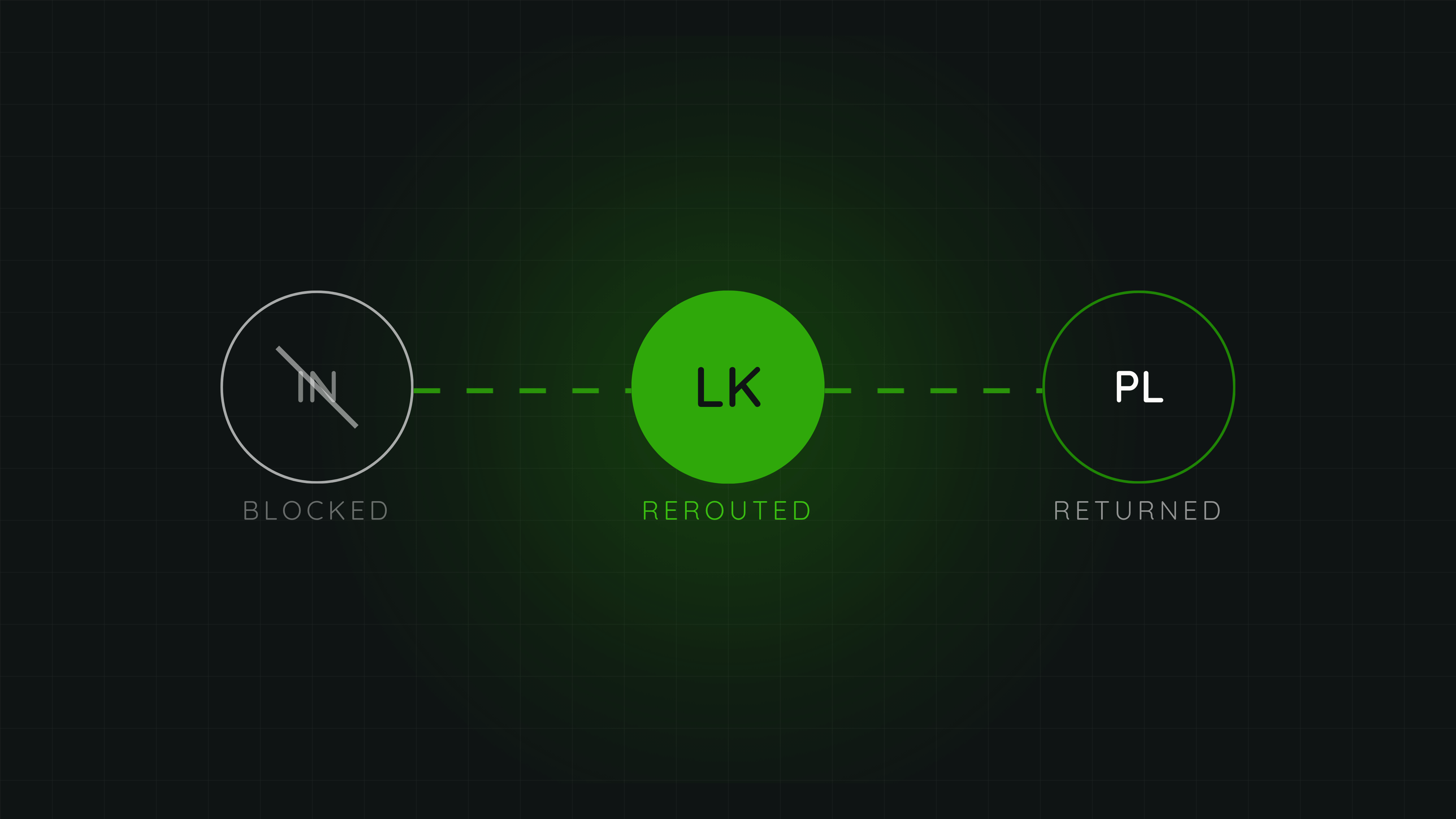
A departing employee at a global technology company was working in India on a tourist visa. Indian customs law blocked the standard laptop return: private exporters without citizenship, residency, or a registered local address cannot export goods without a lengthy process the timeline could not support. The employee was leaving for Sri Lanka within days. Raal negotiated directly with him, he agreed to carry the device with him, and the return kit was dispatched to Sri Lanka instead. The laptop was recovered in full, data wiped, GDPR obligation met.
The Situation
A global technology company with over 2,000 employees had a departing remote employee who had been working in India on a tourist visa. This is a common arrangement in distributed technology teams: people have flexibility over where they work, and India is a popular location for extended remote work periods.
His employment came to an end. The company needed the laptop back. Raal was engaged to handle the retrieval.
The initial plan was straightforward. The employee had the original packaging. The device would be packed, collected, and shipped back to Poland. It was a standard retrieval, until it was not.
The Problem: Indian Customs Law and the Tourist Visa Wall
Indian customs law places specific documentation requirements on private individuals who want to export goods. For a foreign national working in India without permanent residency, meeting those requirements is significantly harder than it appears.
To export a device from India as a private individual, a foreign national is typically required to present one of the following:
- Indian citizenship
- A valid residency permit
- A registered utility bill at an Indian address in their name
The employee had none of these. He was in India on a tourist visa, working remotely for a short period. He had no registered address in India, no residency documentation, no utility bill. Under the standard export process, he could not legally ship the device out of the country without entering a customs procedure that was both slow and uncertain.
This is not an unusual situation. It is an increasingly common one. Remote-first technology companies routinely have people working from countries where they are not citizens and do not hold residency. The assumption that a departing employee can simply ship equipment back from wherever they are is frequently wrong.
A customs broker or freight forwarder can sometimes navigate alternative routes for non-resident exporters in India. But those processes take time: documentation gathering, broker engagement, customs application, processing. The timeline available here made that approach unworkable.
Because the employee was not simply in India waiting. He was leaving the country within days.
The Deadline Made It Critical
The documentation barrier alone would have been a significant challenge. The departure deadline made it a hard one.
Once the employee left India, the window for an India-based retrieval would close permanently. Any approach that depended on Indian customs procedures, even an expedited one, would have run out of time before the device was shipped. The device would not have been recovered.
In most device retrieval cases, the main variable is complexity. In this case, the main variable was time. The question was not just whether a route existed, but whether a route existed that could be executed in the days available.
Related: How to Recover Laptops from Remote Employees When They Resign
How Raal Solved It
When the standard route is blocked, the question becomes: what other routes exist?
The employee was not just leaving India. He had a specific onward destination: Sri Lanka. And Sri Lanka operates under different customs regulations. For a private individual shipping a device from Sri Lanka, the documentation barriers that blocked the India route do not apply in the same way.
Raal opened direct communication with the departing employee. The conversation was practical and transparent. The India export could not happen on the available timeline. Here is why. Here is what we are asking instead: would he be willing to carry the laptop with him when he travelled to Sri Lanka?
He agreed.
"The resolution came from identifying an alternative route quickly and communicating clearly enough with the departing employee that he was willing to help."
Step by Step: What Actually Happened
- India export assessed as non-viable on the available timeline. Tourist visa holder with no residency documentation cannot satisfy Indian customs export requirements for private individuals within days.
- Employee's onward destination confirmed as Sri Lanka. Sri Lanka customs regulations assessed as workable for this type of retrieval.
- Raal communicated directly with the employee. Explained the India documentation problem clearly, explained why the standard route could not work, and asked for his cooperation in carrying the device to Sri Lanka as personal baggage.
- Employee agreed. He carried the laptop with him when he travelled from India to Sri Lanka.
- Return kit dispatched to the employee's Sri Lanka address. Appropriate transit packaging, pre-printed return label, and clear packing instructions included.
- Employee packed the device and completed the return. Carrier collected from his Sri Lanka location.
- Laptop arrived at the destination in Poland. Device received, condition confirmed, passed to the IT team for secure wiping and asset processing.
Results
✓ Device recovered in full. Laptop returned to the company in Poland. Not written off.
✓ Data secured. Device wiped on return. GDPR obligation fulfilled. Certificate of destruction issued.
✓ Timeline met. Retrieval completed before the employee left the region. No window missed.
✓ Employee relationship preserved. Clear communication meant a departing employee cooperated fully with a request that required genuine effort on his part.
What This Means for Global IT Teams
This case illustrates a category of problem that any globally distributed technology company can encounter. It is not an edge case. It is a foreseeable outcome of how distributed work actually operates in 2026.
The tourist visa problem is more common than it appears
Remote-first technology companies routinely have employees working from countries where they are not citizens. A developer on a digital nomad visa in Southeast Asia, an engineer working from South America for a quarter, a product manager on an extended work trip in India. These are normal arrangements. When those people leave the company, the assumption that they can easily ship equipment back from wherever they are is often wrong.
India is among the more restrictive cases for non-resident device exports, but it is not unique. Brazil, several Southeast Asian markets, and others have comparable complexity. The pattern is consistent: standard offboarding assumes the employee is in a country where they have the documentation required to export equipment. That assumption breaks more often than most IT teams realise, because the cases where it breaks typically resolve through improvisation rather than process, and the improvisation is never documented.
Related: Moving IT Devices Across Borders: 21 Countries with the Toughest Regulations
The retrieval window closes faster than expected
The combination of documentation requirements and slow customs processing means a difficult retrieval only gets harder with time. In this case, the employee was leaving the country within days. Any approach that relied on standard customs procedures would have run out of time before the device was shipped.
Identifying the problem quickly and moving to an alternative approach immediately was what made recovery possible. The critical variable was not the logistics. It was the speed of problem identification and decision-making once the standard route was confirmed as blocked.
This is why the retrieval process matters as much as the retrieval outcome. A team that identifies blockers early can reroute. A team that discovers the blocker on collection day cannot.
Related: How to Build an IT Offboarding Process That Actually Works
The departing employee is a partner, not an obstacle
In most difficult retrieval cases, the departing employee is the key variable. They are not malicious. They are distracted, transitioning, and no longer invested in the company's operational problems. Clear, honest communication consistently produces cooperation.
The employee in this case was asked to carry a company laptop across a border as personal baggage. That is not a trivial request. He agreed because the situation was explained clearly and the process was made as easy as possible for him. Raal sent everything to his Sri Lanka address. He only had to pack the device and hand it to a courier.
This model works. It works because it treats the departing employee as a person who is generally willing to help if the request is reasonable and the process is not burdensome. That is almost always true, even in difficult offboarding situations.
A note on sensitive offboarding: Raal operates as a neutral third party in device retrievals. This matters especially in sensitive terminations, where direct contact from HR or management can create friction. A logistics partner with no connection to the employment relationship often gets a better response. Read more about the device recovery process.
Countries Where Non-Resident Device Export Gets Complicated
The India situation is not a one-off. Below are the markets where Raal most frequently encounters documentation complexity for non-resident employees shipping devices out of the country.
| Country | Common Blocker for Non-Residents | Typical Resolution |
|---|---|---|
| India | No residency or utility bill for private export | Alternative route (different departure point, customs broker with extended timeline) |
| Brazil | Complex import/export bureaucracy, CPF requirements | Customs broker engagement, extended timeline |
| China | Strict export controls for electronics | Formal export license process or carrier with specialist China knowledge |
| Indonesia | Documentation requirements for private exporters | Local agent engagement, case-by-case assessment |
| Argentina | Currency controls and import/export licensing | Freight forwarder with Argentina specialism required |
| Saudi Arabia | Specific documentation and carrier requirements | Approved carrier with local customs knowledge |
Related: How to Ship a Laptop Internationally: Customs, Packaging and What Goes Wrong
Related: IT Equipment Policy for Remote Employees: What to Include
What a Good IT Offboarding Process Covers
This case is a retrieval story. But retrieval problems are almost always offboarding process problems first. A well-designed IT offboarding process would have flagged the India documentation issue before the departure deadline became a crisis.
The steps that would have applied here:
- Confirm the employee's current location. Not the address on file. The actual current location. In this case, India rather than the country of employment.
- Assess country-specific export requirements. A standard checklist for international retrievals includes a country assessment step. India's restrictions on non-resident private exporters are documented.
- Open communication with the employee early. Not on the last day. Early enough that alternative routes can be arranged if the standard one is blocked.
- Know the onward travel itinerary. In this case, the employee's travel to Sri Lanka was the alternative route. That information would not have been available if communication had been left too late.
Related: IT Onboarding Checklist for Remote Employees: the full lifecycle starts here
FAQ
Can a tourist visa holder export a laptop from India?
It is significantly more complicated than for a resident. Indian customs regulations for private individual exporters typically require citizenship, a valid residency permit, or a registered utility bill at an Indian address. A foreign national on a tourist visa generally does not have these documents, which means the standard private export route is blocked or subject to a lengthy alternative procedure. In time-sensitive situations, this effectively means the standard route is not viable.
What happens when a remote employee cannot ship a device home from their country?
The options depend on the specific country and the time available. In some cases, a customs broker can navigate an alternative export procedure for non-residents, though this typically takes longer than a standard shipment. In other cases, the viable route is for the employee to physically carry the device to a different country and ship from there. In rare cases where no route is viable and the employee has left, the device may need to be written off, which is why early identification of blockers matters.
How do you recover a laptop from a departing employee who is abroad?
The process starts with confirming the employee's exact current location, not the location on file. Then assessing country-specific export requirements for that location. Then opening direct communication with the employee as early as possible. A third-party logistics partner is often more effective than the company's HR team in this communication, since the employee is no longer invested in the company's operational problems. Raal handles the full process: country assessment, employee communication, packaging dispatch, and carrier coordination. Get an estimate for your retrieval.
Which countries have the most complex regulations for shipping a company laptop internationally?
The markets Raal encounters most frequently for complex retrieval cases are India (non-resident export restrictions), Brazil (bureaucracy and CPF requirements), China (electronics export controls), Indonesia, Argentina, and parts of the Middle East. That said, complexity varies by the specific situation and by whether the employee is a local national or a foreign visitor. See the full country breakdown.
Does Raal handle device recovery from unusual or difficult locations?
Yes. Difficult retrievals, including cases where the standard approach is blocked by customs regulations, documentation gaps, or deadline pressure, are part of what Raal does. The case described in this article is an example of the category: a non-standard situation that required a non-standard solution, found quickly. Describe your situation and get an estimate.
About Raal: Raal handles device logistics for global teams, shipping laptops to new hires and retrieving them from departing employees across 150+ countries. Packaging, customs, insurance, carrier coordination, and employee communication are all included. IT places an order in 5 minutes; Raal handles the rest. Get a live estimate.