TL;DRDevice logistics providers sound similar in a sales call: global coverage, customs handled, fast delivery. The differences show up later, in the pricing fine print, in which countries actually have local execution versus a line on a map, and in what happens when an employee stops responding. This guide covers the twelve questions worth asking any provider, including us, before you sign anything.
Every device logistics vendor's homepage says roughly the same thing: we ship worldwide, customs are handled, your team will love it. That is not useful information, it is the entry price for being in the conversation at all.
The questions that actually separate providers are more specific, and less flattering to ask in a sales call. Here are twelve worth going through before you commit.
The Twelve Questions, at a Glance
| # | QUESTION | WHY IT MATTERS |
|---|---|---|
| 1 | Is pricing per-shipment or subscription? | Determines whether cost scales with actual usage or sits fixed regardless of volume. |
| 2 | Is there a minimum commitment? | Affects flexibility if hiring slows or volume is seasonal. |
| 3 | Which countries have real local execution? | "150+ countries" can mean deep local knowledge or a courier API and hope. |
| 4 | Is insurance included, or an add-on? | Determines your actual exposure if a device is lost or damaged in transit. |
| 5 | Who handles customs documentation? | Manual paperwork per shipment is a hidden IT-hours cost even if "supported." |
| 6 | How is an unresponsive former employee handled? | This is where most retrieval processes actually break down. |
| 7 | Can you place an order today, or is onboarding required first? | Time-to-first-order is a real constraint if you need a device moved this week. |
| 8 | Is there a live asset register, or a static export? | Determines whether your fleet data is current or stale by the time you check it. |
| 9 | Can auditors get direct, read-only access? | Screenshots-before-the-audit vs a system that's always audit-ready are very different. |
| 10 | Does it integrate with your MDM, or replace it? | Some platforms assume you'll drop your existing MDM; others plug into it. |
| 11 | What happens to data on returned devices? | Wiping, verification, and documentation standards vary meaningfully. |
| 12 | What's the provider's actual security posture? | SOC 2, ISO 27001, GDPR compliance, and what's still in progress. Ask directly. |
The Five That Actually Separate Providers
Most of the twelve get a reasonably honest answer in any sales call. These five are where the real differences show up, and where it is worth pushing for specifics.
1. Is pricing per-shipment or subscription, and is there a minimum?
Subscription pricing makes sense at volume, spreading a fixed platform cost across many shipments. At low or uneven volume, it often means paying for capacity you are not using. Ask directly: what would this cost me for exactly the shipments I made last quarter, not a hypothetical average customer. A provider confident in its pricing will run that number with you.
2. Which countries have real local execution versus theoretical coverage?
"150-plus countries" is close to a baseline claim in this category now. The real question is what happens in the specific five or six countries you actually hire in. Ask for a recent example: an order shipped to that exact country, roughly how long it took, and what happened if anything went wrong.
3. How is an unresponsive former employee actually handled?
This is the scenario every provider's marketing glosses over and the one that determines whether retrieval actually works. Ask specifically: what is the process after three unanswered emails? Does someone call? Is HR pulled back in, or does the provider keep coordinating directly? A vague answer here usually means the process is genuinely undefined, not just under-marketed.
4. Can auditors get direct, read-only access, or are you assembling exports before every audit?
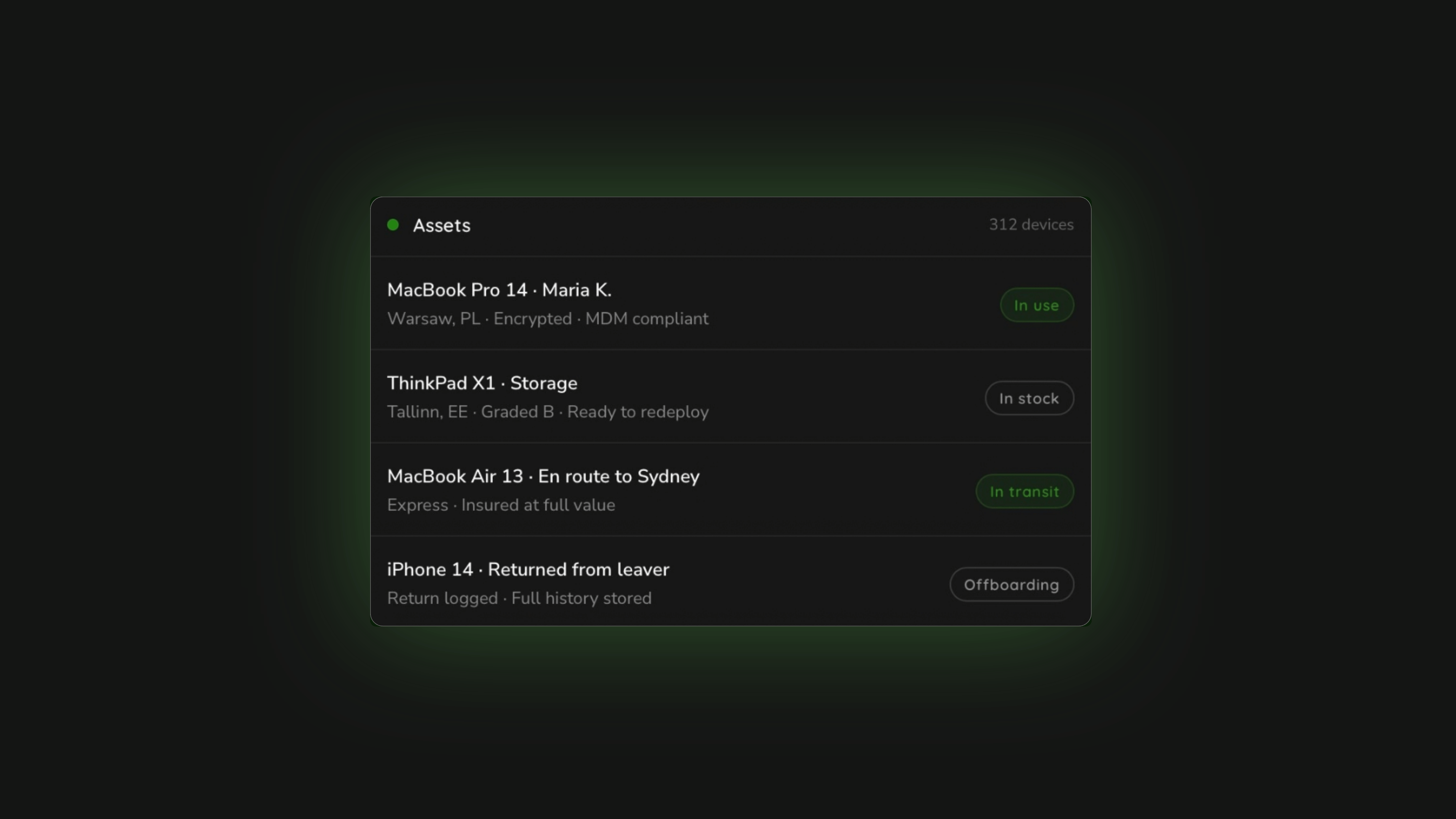
This distinction matters more than it sounds like it should. A system where every device's holder, condition, and history is logged automatically, and where an auditor can be given read-only access directly, is a fundamentally different audit experience than pulling a spreadsheet together the week before a review.
5. What's actually true about the provider's own security posture right now?
Ask plainly what the provider is certified for today, not what is on the roadmap. SOC 2, ISO 27001, GDPR data residency, all of these are either true right now or they are not, and a provider worth working with should be comfortable being specific about which is which, including what they have not achieved yet.
Answering these honestly, about Raal too. OPS credits, per-shipment pricing, no subscription minimum. Full replacement-value insurance and customs handling included in every shipment, not an add-on. Unresponsive former employees are coordinated with directly as a neutral third party, not escalated back to HR. Every device's holder, condition, and history is logged automatically, and auditors can be given direct read-only access. We are not SOC 2 attested yet, that is accurate as of this writing, and it is worth asking us about directly if it matters for your compliance requirements.
Related: GroWrk Alternatives: 6 Tools Compared for IT Device Management
Related: Raal vs Managing IT Devices In-House: Which Actually Makes Sense?
Compare Raal directly against other platforms
FAQ
What's the single most important question on this list?
How an unresponsive former employee is actually handled. It is the scenario every provider's marketing glosses over, and it is the one that most often determines whether a retrieval process works in practice or quietly fails, with the device never coming back.
Should pricing or coverage matter more when comparing providers?
Neither matters in isolation. A provider with excellent coverage at a price structure that does not fit your volume, or cheap pricing with weak execution in the countries you actually hire in, both fail in practice. Ask for pricing against your real, recent shipment history and specific examples in your actual markets, not general claims about either.
Is it reasonable to ask a provider about what they haven't achieved yet, like certifications in progress?
Yes, and a provider's willingness to answer plainly is itself useful information. Every company in this category is at some point in its compliance journey. What matters is whether they will tell you honestly where they stand today rather than implying something that is not yet true.
How many providers should realistically be on a shortlist?
Two or three is usually enough to get a real comparison without the evaluation itself becoming a project. Beyond that, most teams find the marginal differences between additional providers smaller than the cost of evaluating them all.
About Raal: Raal handles IT device logistics for global teams, shipping laptops to new hires and retrieving them from departing employees across 150-plus countries. OPS credit system, no subscription required for low volumes. Get a live estimate.